Complete Guide to Audit Services in UAE (2026)

Table of Contents
Audit services in the UAE verify that a company’s financial records are accurate and compliant. Mainland companies must follow the UAE Commercial Companies Law (Federal Law No. 32 of 2021) and appoint licensed auditors to review annual financial statements according to IFRS standards.
Many free zones also require audits for licence renewal, visa approvals, or banking purposes. Audited reports ensure credibility with investors and banks, while non-compliance can lead to fines, licence issues, and operational restrictions.
This guide covers legal requirements, types of audit services, mainland and free zone rules, and the role of auditors in 2026. It equips business leaders with clear insights to maintain accurate reporting and regulatory compliance.
Audit Services in the UAE
Business audit services look at a company’s financial records, check how numbers were recorded, and confirm they are correct. An audit helps confirm that financial statements reflect real transactions and balances. Audits also examine internal controls and accounting practices that support financial reporting. Audits in the UAE follow the International Standards on Auditing (ISAs), set by global authorities and adopted locally under UAE law.
An audit is an independent inspection. A licensed auditor reviews financial books to find mistakes, errors, missing entries, or non‑compliance with accounting standards. Auditors verify whether the records show a fair and true view of the business’s financial position. This is not just a checklist. Audits help identify issues that might otherwise remain hidden until they become larger problems for the company, its owners, or its stakeholders.
Audit services serve several clear purposes in the UAE business environment:
- Governments sometimes look at audited accounts during compliance reviews.
- Banks request audited financial statements before granting loans or credit facilities.
Investors often review audit reports to assess the reliability of the financial statements before making decisions.
Audits in the UAE typically cover financial data, including income, expenses, assets, liabilities, and cash flows. Auditors also confirm the application of International Financial Reporting Standards (IFRS) in preparing financial statements. Companies using IFRS help maintain global comparability and credibility.
Licensed auditors must be registered with the UAE Ministry of Economy or recognised by relevant free zone authorities. These auditors hold professional qualifications and follow ethical standards. An audit report issued by an approved auditor gives confidence to users of financial statements.
In simple terms, audit services let a company’s financial picture be examined by a qualified outsider who is not part of daily operations. This independent check adds reliability to the numbers and supports trust in how a business reports its financial results.
Why Audit Services Matter for UAE Businesses
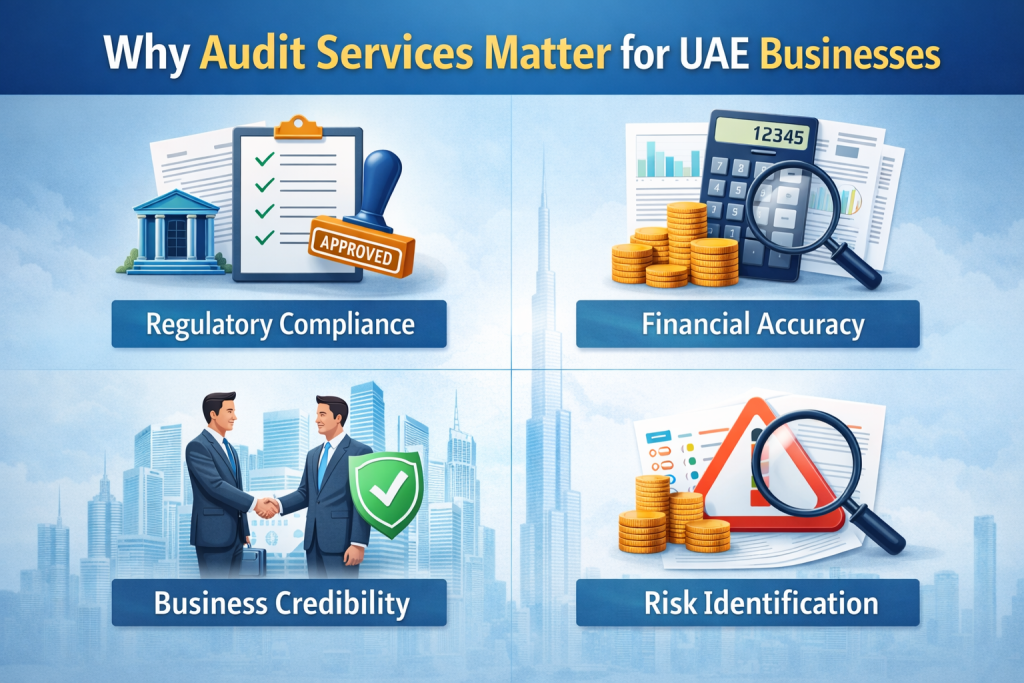
Audit services play a crucial role in maintaining accurate financial records, regulatory compliance, and business credibility in the UAE. Companies rely on audits not only to meet legal obligations but also to identify risks, detect errors, and gain confidence from investors, banks, and stakeholders.
The main reasons auditing is important for UAE businesses can be summarized in the table below:
| Purpose | Description | UAE Context / Example |
| Regulatory Compliance | Ensures companies follow UAE Commercial Companies Law and free zone audit rules | Mainland LLCs must submit annual audited statements; free zones often require audits for license renewal |
| Financial Accuracy | Detects errors, misstatements, and accounting inconsistencies | Avoids penalties for incorrect accounting and ensures IFRS compliance |
| Business Credibility | Builds trust with investors, banks, and stakeholders | Banks usually request audited financials before approving loans or credit facilities |
| Risk Identification | Highlights weaknesses in internal controls and operational risks | Early detection of fraud or process gaps helps companies prevent bigger financial or legal issues |
Auditing is not just a legal requirement. It adds practical value by helping management make informed decisions, improving financial transparency, and maintaining smooth relations with regulators, investors, and banks.
Legal Framework Governing Audit Services in the UAE (2026)
This section outlines the key laws, authorities, and compliance requirements governing audit services for companies operating in the UAE. The legal framework sets out who must audit, what standards apply, and what happens if rules are ignored.
1. UAE Commercial Companies Law (Federal Law No. 32 of 2021)
The main law for governing audit requirements in the UAE is Federal Law No. 32 of 2021 on Commercial Companies. This law applies to companies registered on the UAE mainland and defines statutory audit rules:
Auditors must be independent and hold recognised professional qualifications.
- Every Limited Liability Company (LLC), Public Joint Stock Company (PJSC), and other regulated entities must appoint one or more auditors every year.
- Auditors must be licensed by the UAE Ministry of Economy.
- Financial statements must show a true and fair view of the company’s financial position and follow International Financial Reporting Standards (IFRS).
- Accounting records must be kept for a minimum period (e.g., five years).
- Auditors must be independent and hold recognised professional qualifications.
This law forms the basis for annual audit requirements and sets clear expectations for audited financial statements.
2. Corporate Tax Law (Federal Decree‑Law No. 47 of 2022)
The UAE’s Corporate Tax Law, effective since June 2023, also affects audits:
- Companies with revenue above certain thresholds must maintain audited accounts for tax filings.
- Qualifying Free Zone Persons (QFZPs) may need audited financials to claim 0% tax.
This adds an extra purpose for audits beyond commercial law compliance.
3. Free Zone Authorities and Local Rules
Free zones have their own audit rules:
- Most major free zones, such as DMCC, JAFZA, DIFC, IFZA, RAKEZ, and DSO, require audited financial statements.
- Deadlines, approved auditor lists, and submission processes can differ between authorities.
4. Penalties and Enforcement
Failure to comply can result in fines, denial of license renewal, and regulatory action. Authorities can refuse licence renewals without the required audited statements.
Legal Framework Governing Audit Services in UAE (2026)
UAE Commercial Companies Law and Audit Requirements
The UAE Commercial Companies Law (Federal Law No. 32 of 2021) sets the rules for when audits are mandatory and which companies must comply.
Audit is mandatory when:
- Companies are registered on the mainland and meet minimum capital or revenue thresholds.
- Businesses prepare annual financial statements for submission to authorities, banks, or investors.
- Companies are required to maintain compliance with accounting and reporting standards under UAE law.
Applicable company types:
- Limited Liability Companies (LLCs) – most mainland LLCs must undergo annual audits.
- Public Joint Stock Companies (PJSCs) – mandatory annual audits.
- Branches of foreign companies – audits required if submitting accounts in UAE.
- Other regulated entities – companies in sectors like banking or insurance may face additional audit obligations.
Role of Regulatory Authorities
Different authorities oversee audit compliance:
- Ministry of Economy: Licenses auditors, enforces UAE Commercial Companies Law, and monitors audit standards for mainland companies.
- Free Zone Authorities: Each free zone defines its audit requirements, deadlines, and approved auditor lists. Examples include DMCC, JAFZA, DIFC, RAKEZ, IFZA.
- Other regulators, including banks, sector regulators, and federal authorities, may require audits for licensing, financing, or compliance.
Penalties for Non-Compliance
Companies that fail to conduct audits face both operational and legal risks:
- Audit not conducted: Can lead to inaccurate financial reporting, undetected errors, or potential fraud.
- Regulatory consequences: Authorities can impose fines, block license renewals, suspend business operations, or reject financial statement submissions.
Audits are therefore not optional. They protect the company, satisfy legal obligations, and ensure credibility with banks, investors, and regulators.
Types of Audit Services in UAE

Audit services in the UAE can be broadly divided into Internal Audits, External (Statutory) Audits, and Free Zone-specific Audits. Each type serves a different purpose and has distinct requirements.
1. Internal Audit Services
Internal audits are conducted within the company and focus on operational efficiency, risk management, and internal controls.
Scope and benefits:
| Aspect | Details |
| Purpose | Evaluate internal controls, identify weaknesses, and prevent fraud |
| Focus Areas | Finance, operations, compliance, IT systems |
| Value | Provides management with action |
Internal audits are not legally mandatory for most companies, but they are highly recommended for risk management and governance improvement.
2. External Audit Services
External audits, also called statutory audits, are required by UAE law for mainland companies and by many free zones. Audits must be conducted by licensed auditors approved by the Ministry of Economy or relevant free zone authorities.
Key points:
| Aspect | Details |
| Purpose | Verify financial statements for accuracy and compliance with IFRS |
| Stakeholders | Investors, banks, regulators |
| Legal Requirement | Mandatory for LLCs, PJSCs, and certain foreign branches |
| Report Use | License renewal, bank loans, investor reporting |
External audits provide independent assurance and are essential for credibility in the UAE business environment.
3. Free Zone Audit Services
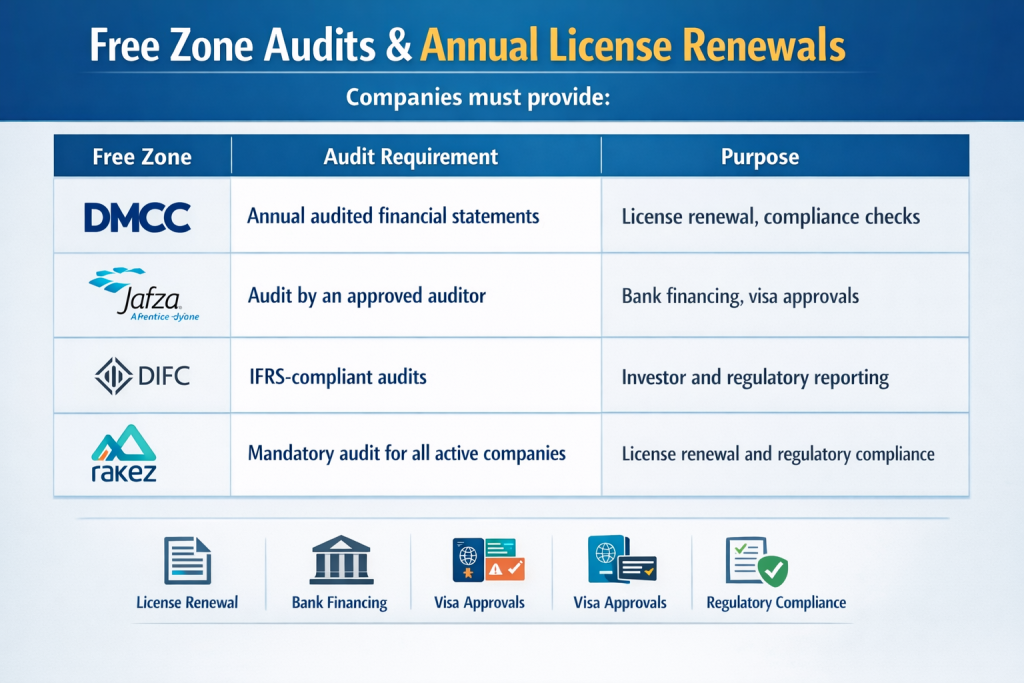
Free zone audits follow authority-specific rules. Each free zone may define deadlines, auditor lists, and reporting formats.
Example requirements:
| Free Zone | Audit Requirement | Purpose |
| DMCC | Annual audited financials | License renewal, compliance check |
| JAFZA | Annual audit by approved auditor | Bank financing, visa approval |
| DIFC | Audits in line with IFRS | Investor and regulator reporting |
| RAKEZ | Mandatory audit for all active companies | License renewal and regulatory compliance |
Free zone audits also ensure that companies maintain transparency and satisfy authority-specific legal and operational requirements.
Financial Audit Services in Dubai and UAE
Financial audits are a specific type of external audit. They focus on examining financial statements to confirm that the company’s numbers are accurate, complete, and comply with applicable standards. These audits are essential for banks, investors, regulators, and company management.
1. What Is a Financial Audit
A financial audit reviews a company’s financial statements, including the balance sheet, income statement, and cash flow statement. Auditors verify that the reported figures match the underlying transactions and records.
Key points:
- Confirms the accuracy of financial data.
- Ensures compliance with IFRS standards.
- Highlights errors or misstatements that may affect decision-making.
Financial audits also verify accounting policies, internal controls, and reporting practices. They provide an independent view of the company’s financial health.
2. When Financial Audits Are Required
Financial audits are typically required in the following situations:
| Situation | Requirement | Reference / Example |
| Annual Compliance | Most mainland companies and some free zone companies must submit audited financials annually | UAE Commercial Companies Law |
| Banking & Loans | Banks often request audited statements before approving credit facilities | Standard practice in Dubai banks |
| Investor Reporting | Investors rely on audits for mergers, acquisitions, or equity investments | IFRS-compliant audited reports improve trust and transparency |
| License Renewal | Some free zones require audited statements for annual license renewal | DMCC, JAFZA, DIFC regulations |
3. Financial Audit Reports and Their Uses
Financial audit reports provide a formal statement from a licensed auditor about the accuracy of financial statements. They serve multiple purposes:
- Support license renewal and regulatory compliance.
- Help banks assess creditworthiness and approve loans.
- Guide investors in financial decision-making.
- Assist management in identifying financial risks and improving controls.
A properly prepared financial audit report enhances business credibility, reduces risk, and ensures compliance with UAE regulations.
1. Who Are Approved Auditors
Approved auditors meet professional qualifications and hold licenses issued by the UAE Ministry of Economy or by relevant free zone authorities.
Key points:
- Registered and licensed to perform statutory audits.
- Must follow International Standards on Auditing (ISA).
- Independent of the company they audit.
- Recognised by authorities for submission of official reports.
Approved auditors often belong to globally recognised professional bodies such as ACCA, CPA, or CA.
2. Why Approved Auditors Are Important
Using an approved auditor provides several advantages:
| Benefit | Explanation |
| Authority Acceptance | Audit reports are officially accepted for license renewal and regulatory submission |
| Credibility | Increases trust with banks and investors |
| Compliance Assurance | Confirms adherence to IFRS and UAE regulations |
| License Renewal | Some free zones require audited statements for annual license renewal |
3. Difference Between Approved and Non-Approved Auditors
| Aspect | Approved Auditor | Non-Approved Auditor |
| License | Licensed by the Ministry of Economy or the Free Zone Authority | No official recognition |
| Report Acceptance | Accepted by regulators, banks, and investors | May be rejected for official use |
| Standards | Follows IFRS and ISA standards | May not follow recognized standards |
| Credibility | High trust and legal validity | Limited credibility and compliance risk |
Audit Services for Mainland Companies
Mainland companies in the UAE must comply with strict audit requirements under the UAE Commercial Companies Law (Federal Law No. 32 of 2021). Audits ensure financial transparency, support regulatory compliance, and protect business credibility.
1. Mainland Audit Requirements
Mainland companies must appoint licensed auditors for their annual statutory audits. Key requirements include:
- Annual statutory audit: All mainland LLCs, PJSCs, and certain foreign branches must submit audited financial statements.
- Compliance with IFRS: Financial statements must follow International Financial Reporting Standards to ensure accuracy and global comparability.
- Submission to authorities: Audited accounts are required for the Ministry of Economy during license renewals and corporate compliance checks.Independent auditors: Auditors must not be part of company management or involved in daily operations.
Record retention: Companies must maintain accounting records for at least five years.
These audits are mandatory to maintain legal standing and credibility with banks, investors, and regulators.
2. Common Audit Challenges for Mainland Businesses
Mainland companies often face practical challenges when conducting audits:
| Challenge | Explanation |
| Incomplete records | Missing invoices, receipts, or accounting entries delay audits |
| Delayed audits | Postponing audit preparation can lead to fines or license renewal issues |
| Non-compliance with IFRS | Using incorrect accounting standards affects report validity |
| Hiring unapproved auditors | Audits by unlicensed auditors are rejected by regulators |
Proper preparation, clear record-keeping, and the use of approved auditors help mainland companies overcome these challenges.
Audit Services for Free Zone Companies
Free zone companies in the UAE must comply with audit rules set by the relevant authority. These rules differ across zones but generally ensure financial transparency, compliance, and accurate reporting.
1. Free Zone Audit Obligations
Free zone authorities require companies to submit audited financial statements annually. Key points include:
- Authority-specific requirements: Each free zone defines the audit scope, approved auditors, and submission deadlines.
- IFRS compliance: Financial statements must follow International Financial Reporting Standards.
- Audit timing: Most free zones require audits to be completed before license renewal or annual filings.
- Audit by approved auditors: Reports must be prepared by auditors recognized by the relevant free zone authority.
These audits ensure compliance with applicable regulations and help companies avoid fines or license suspensions.
2. Audit Reports for Free Zone License Renewals
Free zone audits are often directly linked to annual license renewals. Companies must provide:
| Free Zone | Audit Requirement | Purpose |
| DMCC | Annual audited financial statements | License renewal, compliance checks |
| JAFZA | Audit by an approved auditor | Bank financing, visa approvals |
| DIFC | IFRS-compliant audits | Investor and regulatory reporting |
| RAKEZ | Mandatory audit for all active companies | License renewal and regulatory compliance |
Free zone audits also ensure transparency for shareholders, regulators, and banks. Delayed or incomplete audits can delay or prevent license renewals, visa processing, or access to banking facilities.
How to Choose the Best Audit Firms in Dubai
- Verify the firm has licensed and approved auditors recognized by the Ministry of Economy or the relevant free zone.
- Check the experience of the firm in auditing companies of your industry and size.
- Ensure the auditors are familiar with the UAE Commercial Companies Law, IFRS, and corporate tax requirements.
- Assess the quality and clarity of past audit reports to confirm they provide actionable insights.
- Confirm the firm’s ability to meet deadlines for annual audits and free zone submissions.
- Ask about banking and investor experience to ensure their reports are accepted by banks and stakeholders.
- Evaluate the audit process and methodology for accuracy, risk detection, and compliance.
- Consider reputation and references from other clients in Dubai and UAE.
- Avoid firms with unrealistically low fees, unlicensed auditors, or poor communication.
Role of Audit Firms in Business Growth and Stability
Audit firms do more than check numbers. Their work supports business decision-making, strengthens credibility, and helps companies grow while staying compliant.
Key Roles of Audit Firms
- Supporting Banking and Financing – Audited financial statements from an approved auditor are typically required for bank loans, credit facilities, and corporate financing. Banks rely on these reports to assess risk and creditworthiness.
- Supporting Business Expansion – Companies planning mergers, acquisitions, or branch openings can use audit reports to provide transparent financial data to investors and regulators.
- Investor Confidence and Due Diligence – Accurate audits build investor trust. Stakeholders can review financial health before making investment decisions.
- Identifying Financial Risks – Auditors detect weaknesses in internal controls, errors, and potential fraud, helping management prevent losses and improve processes.
- Ensuring Legal Compliance – Audit firms ensure companies follow UAE Commercial Companies Law, free zone regulations, and IFRS standards, avoiding fines or license issues.
- Supporting Corporate Governance – Internal and external audits improve accountability and oversight, which strengthens overall governance structures.
- Improving Decision-Making – Management can rely on accurate financial data for budgeting, forecasting, and strategic planning.
Maintaining Business Reputation – Regular audits by approved auditors demonstrate professionalism, credibility, and compliance to regulators, banks, and partners.
Common Audit Mistakes UAE Businesses Should Avoid
Many UAE businesses face delays, fines, or compliance issues due to simple audit mistakes. Avoiding these errors helps ensure accurate financial reporting and a smooth regulatory approval process.
1. Poor Record Keeping
Incomplete invoices, receipts, and accounting entries make audits longer and increase the risk of errors. Maintaining organised financial records prevents delays and penalties.
2. Delayed Audits
Postponing audit preparation can block license renewals, bank approvals, or investor reporting. Scheduling audits on time ensures compliance with deadlines set by mainland or free zone authorities.
3. Hiring Unqualified or Non-Approved Auditors
Audits conducted by unlicensed auditors are often rejected by regulators and banks. Always use auditors approved by the Ministry of Economy or the relevant free zone authority.
4. Non-Compliance with IFRS
Using incorrect accounting standards or failing to follow IFRS can invalidate financial statements. Ensure all financial statements adhere to international and UAE standards.
5. Ignoring Free Zone-Specific Rules
Each free zone has its own audit deadlines, approved auditors, and reporting formats. Ignoring these requirements can delay license renewals or cause regulatory penalties.
6. Inadequate Internal Controls
Weak internal control systems can result in errors or fraud that auditors may identify. Strengthening controls improves accuracy and reduces risks.
7. Not Preparing Supporting Documents
Auditors need detailed supporting documents for all transactions. Missing documents increase the risk of audit adjustments or regulatory queries.
Future of Audit Services in UAE (2026 and Beyond)
Audit services in the UAE are evolving as regulations tighten, businesses grow, and global standards advance. Companies and auditors must adapt to maintain compliance and financial transparency.
1. Regulatory Trends
Authorities are increasing audit oversight for companies in both the mainland and the free zone. Expect more strict enforcement of UAE Commercial Companies Law and corporate tax compliance. Regulators may introduce additional reporting requirements and tighter deadlines.
2. Increased Compliance Focus
Businesses will face higher expectations for accurate, timely, and IFRS-compliant financial statements. Free zones may expand their audit scope, requiring greater transparency in license renewals, visa approvals, and banking processes.
3. Growing Demand for Professional Auditors
The need for licensed and experienced auditors is rising due to business expansion, corporate tax implementation, and investor scrutiny. Companies increasingly rely on auditors not only for statutory compliance but also for risk management and business insights.
4. Technology Adoption
Auditors are adopting digital tools for data analysis, automated reconciliations, and reporting efficiency. Cloud accounting, ERP integration, and secure document sharing are becoming standard practices, improving audit accuracy and speed.
5. Enhanced Transparency for Investors and Banks
Financial reporting expectations are rising. Companies will need detailed audit trails and transparent records to maintain credibility with banks, investors, and regulators.
Why Prime Edge Tax Consultant for Audit Services in UAE
Prime Edge Tax Consultant provides professional audit services in the UAE with a focus on compliance, credibility, and business support. The firm combines experience, approved auditors, and practical reporting to meet mainland and free zone requirements.
1. Approved Auditors in Dubai
All audits are conducted by licensed and Ministry of Economy-approved auditors. Reports prepared by Prime Edge are recognized by regulators, banks, and investors.
2. Experience Across Mainland and Free Zones
Prime Edge has extensive experience in mainland companies and multiple free zones, including DMCC, JAFZA, DIFC, RAKEZ, and IFZA. The firm understands each authority’s audit rules, deadlines, and submission processes.
3. Practical and Clear Audit Reporting
Audit reports are detailed, clear, and actionable, helping management identify risks, improve processes, and maintain compliance. Reports also comply with IFRS standards, ensuring regulatory and stakeholder acceptance.
4. Support for Banks and Investors
Prime Edge prepares reports that are widely accepted by banks for credit facilities and by investors for due diligence. This ensures smooth financing and investment processes.
5. Compliance Assurance
The firm helps companies avoid penalties, fines, and delays by ensuring that audits comply with UAE laws, free zone rules, and corporate tax requirements.
Using Prime Edge Tax Consultant ensures businesses in Dubai and across the UAE maintain accurate financial reporting, regulatory compliance, and credibility with all stakeholders.
Final Thoughts on Audit Services in UAE
Audit services ensure financial accuracy, regulatory compliance, and business credibility for both mainland and free zone companies. Following UAE Commercial Companies Law, free zone rules, and IFRS standards allows businesses to maintain legal standing and meet regulator expectations.
Timely audits help companies identify risks, correct errors, and build trust with banks, investors, and stakeholders. Avoiding mistakes such as poor record-keeping, delayed audits, or the use of unapproved auditors is essential to prevent fines, license issues, or operational delays.
The future of audit services emphasizes stricter regulations, corporate tax compliance, and technology adoption. Engaging licensed and experienced auditors, such as Prime Edge Tax Consultant, ensures accurate reporting, smoother operations, and stronger stakeholder confidence.