
Corporate Tax vs VAT: What’s the Difference?
The UAE built its global reputation on being a tax-free business hub. That reputation doesn’t fully hold anymore. Business owners now operate under two separate tax systems, and mixing them up is one of the most common (and costly) mistakes new companies make.
VAT UAE came first. The Federal Tax Authority introduced it in January 2018 at a standard rate of 5%, applied to most goods and services sold within the country. It was the government’s first real move toward a modern, diversified revenue base system. It caught a lot of business owners off guard because the UAE simply hadn’t taxed transactions before.
Then, in June 2023, the UAE rolled out Corporate Tax UAE, a federal tax on business profits set at 9% for taxable income above AED 375,000. According to the Ministry of Finance, the goal was to align the UAE with international tax standards while keeping the country competitive for investment. Now many businesses manage both Corporate Tax and VAT, each with its own registration requirements, filing deadlines, compliance obligations, and penalties for non-compliance.
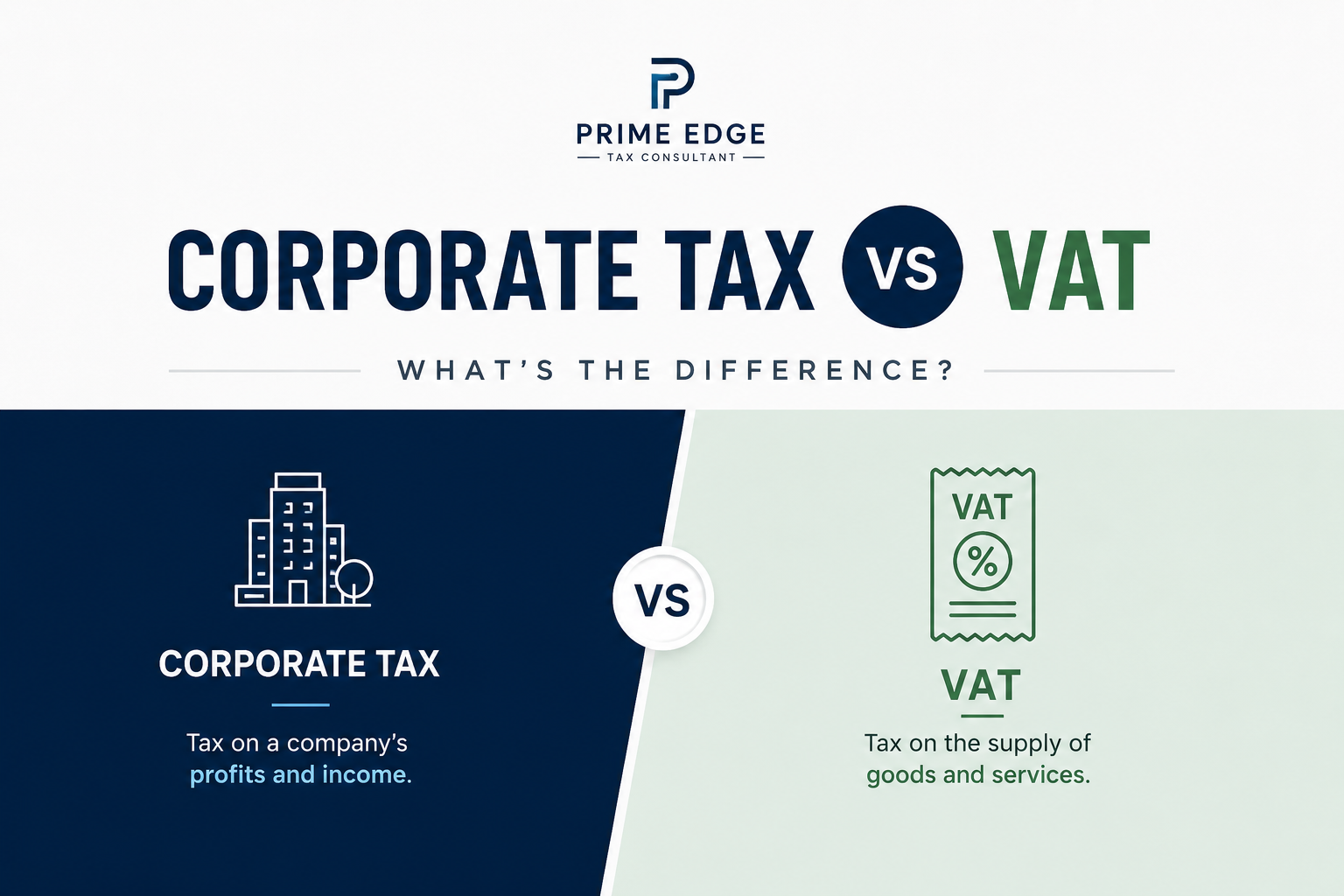
So what is Corporate Tax, really, and how does it differ from VAT? The short answer: VAT taxes what a business sells; Corporate Tax taxes what a business keeps. One gets collected from customers at the point of sale. The other gets calculated at year-end, after expenses come off the top.
This guide breaks down Corporate Tax vs VAT step by step: rates, registration rules, filing deadlines, and the real differences that affect your bottom line. By the end, you’ll know exactly where your business stands under both.
What Is Corporate Tax in UAE?
Corporate Tax UAE is a direct federal tax on a company’s net profit. The government takes a share of what your business actually earns after expenses, not a share of what it sells. That’s the core distinction people miss when they first hear about it.
The tax is not new anymore, but it’s still young. It came into effect for tax periods starting on or after June 1, 2023, under Federal Decree-Law No. 47 of 2022 on the Taxation of Corporations and Businesses. This federal law governs how corporate income tax UAE works, from who’s liable to how taxable income gets calculated. Before this, the UAE had no federal profit tax at all, which is part of why so many business owners are still catching up on the rules.
Who Does Corporate Tax Apply To?
The law casts a wide net. It covers:
- Mainland companies — LLCs and other UAE-incorporated businesses
- Free zone companies — even though many still qualify for a 0% rate under specific conditions
- UAE branches of foreign companies
- Foreign businesses with a permanent establishment or UAE-sourced income
- Individuals (natural persons) running a business or freelance activity with turnover above AED 1 million
How Taxable Income Gets Calculated
Corporate Tax doesn’t work off your total revenue. It works off net profit, then adjusts that number based on rules set out in the law.
Here’s the basic flow:
- Start with the company’s net accounting profit, based on standard financial statements
- Apply adjustments where some income is exempt, some expenses aren’t deductible, and reliefs like Small Business Relief or loss carry-forwards can reduce the final figure.
- What’s left after those adjustments is the taxable income the 9% rate applies to
UAE Corporate Tax Rate
The rate structure is simpler than people expect once you see it laid out:
| Taxable Income | Rate |
| Up to AED 375,000 | 0% |
| Above AED 375,000 | 9% |
What Is VAT in UAE?
VAT UAE stands for Value Added Tax. It’s a consumption tax, meaning it gets charged on the sale of goods and services rather than on income or profit. The UAE introduced it in January 2018 at a standard rate of 5%, making it one of the lowest VAT rates in the world compared to Europe, where rates often sit between 17% and 27%.
Unlike Corporate Tax, VAT isn’t new to most business owners anymore. It’s been part of daily operations for over seven years now, and most companies have already built it into their pricing and invoicing systems. Still, plenty of confusion remains about how it actually works behind the scenes.
How VAT Works
VAT gets applied at every stage of the supply chain, not just at the final sale. A manufacturer charges VAT to a wholesaler. The wholesaler charges VAT to a retailer. The retailer charges VAT to the end customer. At each stage, the business collects VAT on what it sells (output VAT) and can reclaim the VAT it paid on business purchases (input VAT).
The Consumer Tax Concept
Here’s the part that trips people up: businesses collect VAT, but they don’t pay it out of their own pocket.
Think of a business as a middleman for the government. A retailer adds 5% VAT to the price a customer pays. That 5% never belonged to the retailer. It gets set aside and handed over to the FTA during the filing period. The end consumer is the one who actually bears the cost, since they’re the last link in the chain with no one to pass the charge on to.
This is what separates VAT from Corporate Tax at a fundamental level. Corporate Tax hits the business directly, out of its own profit. VAT passes through the business and lands on the customer.
VAT Registration Requirements
Registration isn’t optional once a business crosses a certain revenue level. The rules break down like this:
- Mandatory registration — required once taxable turnover exceeds AED 375,000 in 12 months
- Voluntary registration — available for businesses with taxable turnover or expenses above AED 187,500, useful for startups that want to reclaim input VAT early
- No registration needed — businesses below the voluntary threshold don’t need to register, though many choose to anyway for credibility with suppliers and clients
VAT Return Filing
Once registered, a business needs to file VAT returns on a regular schedule set by the FTA, typically quarterly, though some larger businesses get assigned monthly filing periods. Each return needs to show:
- Total sales and output VAT collected
- Total purchases and input VAT paid
- The net VAT amount owed to the FTA or due to be refunded
Corporate Tax vs VAT: Key Differences
| Basis | VAT | Corporate Tax |
| Type of tax | Indirect (consumption tax) | Direct (profit tax) |
| What’s taxed | Sale of goods and services | Net business profit |
| Standard rate | 5% | 0% up to AED 375,000, then 9% |
| Who bears the cost | End consumer | The business itself |
| Who collects/pays it | Business collects it, then remits to FTA | Business pays it directly to FTA |
| Governing law | Federal Decree-Law No. 8 of 2017 | Federal Decree-Law No. 47 of 2022 |
| Registration threshold | AED 375,000 (mandatory), AED 187,500 (voluntary) | No revenue threshold — registration is mandatory for all businesses in scope |
| Filing frequency | Usually quarterly | Annually |
| Calculated on | Transaction value | Adjusted accounting profit |
| Applies to | Businesses selling taxable goods/services | UAE resident companies, branches, PEs, and individuals with turnover above AED 1 million |
How Corporate Tax and VAT Affect UAE Businesses
SMEs
Small and medium businesses got some breathing room built into the system. Corporate Tax charges 0% on the first AED 375,000 of taxable income, which shields most small businesses from paying anything at all in the early years.
Beyond that, the FTA introduced Small Business Relief (SBR), a transitional measure that treats eligible businesses as having zero taxable income entirely. To qualify, revenue generally needs to stay under AED 3 million in the relevant tax period, and this relief is available for tax periods ending on or before December 31, 2026, so it’s a temporary window, not a permanent feature.
VAT works differently for SMEs. Registration depends purely on turnover, not on business size or structure. Cross AED 375,000 in taxable turnover, and registration becomes mandatory regardless of how many employees you have or how established the business is.
Startups
New companies face a tighter timeline than most people expect. Corporate Tax registration is required within three months of incorporation, even for a business that hasn’t turned a profit.
A startup can register, file a return showing zero taxable income, and still stay fully compliant, but skipping registration altogether triggers penalties regardless of how small the business is.
VAT registration usually comes later for startups, since it’s tied to revenue thresholds rather than incorporation dates. Many founders register voluntarily anyway, once turnover or expenses pass AED 187,500, mainly to reclaim VAT on setup costs like equipment, software, and office fit-outs.
Free Zones
Free zone companies get the most complicated version of Corporate Tax, even though the marketing usually says otherwise. Being registered in a free zone doesn’t automatically mean 0% tax. That benefit only applies to a business that qualifies as a Qualifying Free Zone Person (QFZP), and even then, only on Qualifying Income.
To hold QFZP status, a company generally needs to:
- Maintain real economic substance within the free zone
- Earn income that falls within the definition of Qualifying Income
- Stay under the de minimis limit for non-qualifying income
- Meet transfer pricing requirements
- Keep audited financial statements
Mainland Companies
Most mainland companies operating in the UAE are subject to Corporate Tax on their taxable profits and must comply with the applicable registration and filing requirements.
Businesses that exceed the VAT registration threshold must also charge VAT on taxable goods and services, submit periodic VAT returns, and pay any tax due to the Federal Tax Authority. Proper accounting systems are essential for calculating both taxes accurately and meeting reporting deadlines.
Compliance Requirements
Every business should establish processes to meet its Corporate Tax and VAT obligations. Strong compliance practices reduce the risk of penalties and make tax reporting more efficient.
Key compliance requirements include:
- Registering for Corporate Tax and VAT when required
- Maintaining accurate accounting records and supporting documents
- Issuing VAT-compliant tax invoices
- Calculating taxable income and VAT correctly
- Filing Corporate Tax and VAT returns within the prescribed deadlines
- Retaining financial records for the period required under UAE tax laws
Corporate Tax Registration vs VAT Registration in UAE
Corporate Tax Registration
Businesses that fall within the scope of the UAE Corporate Tax Law must register with the Federal Tax Authority (FTA) and obtain a Corporate Tax Registration Number. Registration is required even if a business qualifies for a 0% Corporate Tax rate, as long as it is subject to the law.
Eligible Businesses
Corporate Tax registration generally applies to:
- Mainland companies operating in the UAE
- Foreign companies with a taxable presence in the UAE
- Sole proprietorships and individuals conducting business activities that fall within the scope of Corporate Tax
- Free Zone businesses that are subject to the Corporate Tax regime
Required Documents
The FTA may require documents such as:
- Trade license
- Emirates ID or passport of the owner or authorized signatory
- Memorandum of Association (where applicable)
- Business contact details
- Information about the company’s business activities
- Financial and ownership details, where required
Filing Requirements
After registration, businesses must:
- Maintain accurate accounting records
- Calculate taxable income in accordance with the Corporate Tax Law
- Submit Corporate Tax returns within the prescribed deadlines
- Pay any Corporate Tax due on time
- Keep financial records and supporting documents for the required retention period
VAT Registration
VAT registration is based primarily on the value of a business’s taxable supplies and imports. Once registered, a business receives a Tax Registration Number (TRN) and must comply with UAE VAT regulations.
Mandatory Threshold
A business must register for VAT if its taxable supplies and imports exceed the mandatory registration threshold set by the Federal Tax Authority. Once the threshold is reached, registration should be completed within the required timeframe to avoid penalties.
Voluntary Registration
Businesses that do not meet the mandatory threshold may still choose voluntary registration if they satisfy the voluntary registration requirements. Voluntary registration can benefit businesses by allowing them to recover eligible input VAT and enhance their credibility with customers and suppliers.
Tax Registration Number (TRN)
After successful VAT registration, the Federal Tax Authority issues a Tax Registration Number (TRN). This unique number identifies the business as a VAT-registered entity.
A TRN must appear on VAT-compliant tax invoices and is used when filing VAT returns, paying VAT liabilities, and communicating with the FTA. Businesses should ensure their TRN is used correctly on all relevant tax documents and records.
Common Mistakes Businesses Make With UAE Tax Compliance
Missing Filing Deadlines
- Businesses miss registration, tax return, or payment deadlines due to not tracking their compliance calendar.
- Late submissions can lead to financial penalties and unnecessary administrative issues.
Incorrect VAT Returns
- Businesses may report incorrect sales figures, claim ineligible input VAT, or miscalculate the amount of VAT payable.
Poor Accounting Records
- Incomplete or inaccurate accounting records make it difficult to calculate Corporate Tax and VAT correctly.
- Missing invoices, unrecorded transactions, and poorly organized documentation can create compliance problems and complicate tax audits.
Not Understanding Taxable Income
- Incorrectly assuming that all revenue is taxable or failing to account for allowable deductions and adjustments when calculating Corporate Tax can cause overpayment or underpayment of tax.
Ignoring FTA Requirements
- The Federal Tax Authority has established clear rules for tax registration, invoicing, record keeping, return filing, and tax payments. Businesses that overlook these requirements risk penalties and compliance issues.
Why Hire a Tax Consultant in UAE?
Tax Planning
Effective tax planning helps businesses understand their tax obligations, identify available reliefs, and structure their finances efficiently. A qualified corporate tax consultant Dubai can provide practical guidance that supports long-term business goals while remaining compliant with UAE tax laws.
Compliance Support
Tax regulations continue to evolve, making ongoing compliance essential. A professional consultant helps businesses complete registrations, maintain accurate records, and meet all Federal Tax Authority (FTA) requirements, reducing the risk of errors and penalties.
VAT Filing
Preparing and submitting VAT returns requires accurate calculations and proper documentation. An experienced VAT consultant UAE reviews transactions, prepares VAT returns, and ensures filings are completed correctly and on time.
Corporate Tax Preparation
Corporate Tax preparation involves calculating taxable income, applying the relevant tax rules, and preparing accurate tax returns. PTC provides professional guidance that helps businesses submit complete and compliant returns while avoiding common filing mistakes.
Risk Reduction
Tax mistakes can result in penalties, audits, and unnecessary compliance challenges. Our experienced tax consultant in the UAE helps you identify risks early and improve your tax processes. At PTC, we ensure your business meets all Corporate Tax and VAT requirements accurately and on time.
Frequently Asked Questions About Corporate Tax vs VAT
1. What is the main difference between Corporate Tax and VAT in the UAE?
Corporate Tax is a direct tax charged on a business’s taxable profits, while VAT is an indirect tax charged on the sale of most goods and services. Businesses pay Corporate Tax on their profits, whereas VAT is collected from customers and remitted to the Federal Tax Authority (FTA).
2. Do all businesses need to register for both Corporate Tax and VAT?
No. Corporate Tax and VAT have different registration requirements. Businesses must determine whether they meet the eligibility criteria for Corporate Tax registration and whether their taxable turnover requires VAT registration.
3. What is the Corporate Tax rate in the UAE?
The UAE applies a 0% Corporate Tax rate on taxable income up to AED 375,000 and a 9% rate on taxable income exceeding AED 375,000.
4. What is the VAT rate in the UAE?
The standard VAT rate in the UAE is 5% on most taxable goods and services.
5. Can a business be registered for VAT but not pay Corporate Tax?
Yes. Depending on its business activities and taxable income, a business may be required to register for VAT while having no Corporate Tax liability or benefiting from the 0% Corporate Tax rate.
6. What happens if a business misses a tax filing deadline?
Missing Corporate Tax or VAT filing deadlines may result in penalties, interest, and other compliance actions by the Federal Tax Authority (FTA). Businesses should file returns and make payments within the prescribed deadlines.
7. Why should I hire a tax consultant in the UAE?
A professional tax consultant can assist with Corporate Tax registration, VAT registration, tax planning, return filing, compliance reviews, and ongoing support to help your business meet UAE tax regulations and reduce the risk of penalties.
