
Complete Guide to Accounting Services in UAE (2026)

Table of Contents
Businesses in UAE operate in a regulated financial environment where accurate accounting is a legal and operational requirement. Accounting services in UAE record financial transactions, classify data, prepare reports, and ensure compliance with national laws and international standards. Companies must maintain proper books to show their financial position, tax liability, and operational performance. Authorities such as the Ministry of Economy and the Federal Tax Authority review financial records during inspections, tax filings, and compliance checks.
Accounting forms the foundation of financial control. Proper records help companies track income, expenses, assets, liabilities, and cash flow. Management teams rely on accounting reports for pricing decisions, budgeting, forecasting, and cost control. Investors and banks also examine financial statements before funding or approving credit. Strong accounting improves credibility and reduces the risk of penalties or reporting errors.
Accounting rules in the country follow globally accepted reporting frameworks such as IFRS. These standards define how companies must recognize revenue, record expenses, value assets, and disclose financial information. Businesses that fail to maintain compliant records can face fines, rejected filings, or tax reassessments. Accurate accounting therefore protects operations, supports compliance, and strengthens financial transparency.
This guide provides a detailed overview of accounting services in Dubai and across the country. You will learn service types, regulatory requirements, reporting standards, tax obligations, and how professional accounting firms support businesses. Each section focuses on practical knowledge to help business owners, finance teams, and decision-makers understand how accounting works in real-world business conditions in 2026.
Accounting Services in UAE
What Are Accounting Services
Accounting services record, organise, and report a business’s financial data. Accountants track every transaction, such as sales, expenses, payroll, assets, and liabilities. Records form the basis of financial statements, including the profit and loss statement, the balance sheet, and the cash flow statement. Authorities, such as the Federal Tax Authority, review these records during tax assessments and compliance reviews. Accurate accounting helps companies present clear financial positions to regulators, banks, and investors.
Core accounting functions include journal entries, ledger maintenance, reconciliations, and financial reporting. Professionals also verify the classification of expenses, revenue recognition, and asset valuation rules. Standards issued by the International Accounting Standards Board guide how financial data must appear in reports. Proper application of these rules prevents reporting errors and compliance violations.
Business operations depend on structured financial data. Owners monitor profit margins, cost ratios, and liquidity through accounting reports. Managers analyze numbers before approving budgets or expansion plans. Lenders review statements before issuing loans. Reliable accounting therefore supports daily decisions and long-term planning.
Why Accounting Matters for UAE Businesses
Financial visibility stands as a primary reason companies maintain accounting systems. Clear records show revenue trends, expense patterns, and net profit levels. Leadership teams use these insights to adjust pricing, reduce unnecessary costs, and improve margins.
Compliance remains another major factor. Tax laws require proper documentation of income, input tax, and deductible expenses. Missing records can trigger penalties or reassessments. Regulators also request statements during inspections or license renewals. Organized accounting reduces such risks.
Decision support also depends on accounting accuracy. Investors analyze statements before funding a company. Banks evaluate financial ratios before approving credit. Suppliers review payment history before extending trade credit. Strong financial records increase trust and credibility across all business relationships.
Difference Between Accounting and Bookkeeping
Bookkeeping focuses on recording daily transactions. Bookkeepers enter invoices, receipts, payments, and bank activity into accounting systems. Their work keeps financial data up to date and structured.
Accounting service covers analysis and interpretation of that data. Accountants review entries, adjust errors, prepare statements, calculate taxes, and assess financial performance. Strategic insights come from accounting, not bookkeeping.
Practical impact shows clearly in business operations. Bookkeeping keeps records organized. Accounting explains what those records mean. Companies need both functions to maintain compliance, understand performance, and plan growth.
Scope of Accounting Services in Dubai and UAE
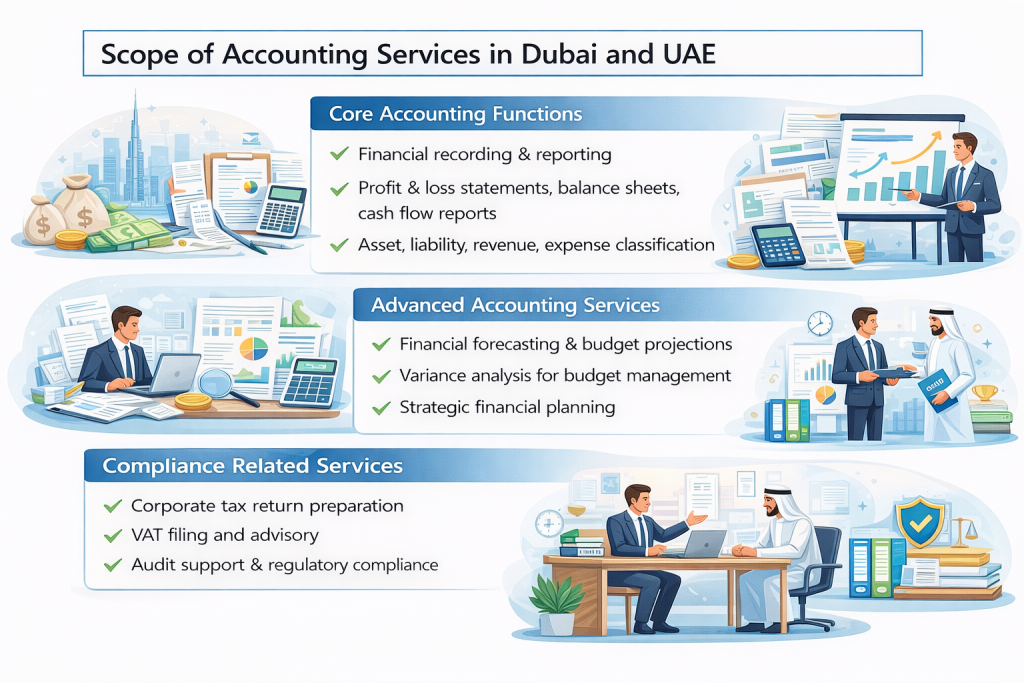
Core Accounting Functions
Accounting services in UAE cover structured financial recording and reporting tasks that every registered company must maintain under commercial regulations. Accountants record transactions, post entries into ledgers, reconcile bank balances, and prepare trial balances. These steps lay the foundation for the financial statements required by regulators in the UAE.
Accounting services in Dubai also include preparing profit and loss statements, balance sheets, and cash flow reports. Authorities such as the Federal Tax Authority review these records during tax filing or audits. Companies that maintain updated books face fewer compliance issues and avoid reporting disputes.
Financial accounting services ensure the proper classification of assets, liabilities, revenue, and expenses in accordance with international reporting principles. Standards issued by the IFRS Foundation guide recognition rules and disclosure structure. Correct application supports transparency and regulatory acceptance.
Advanced Accounting Services
Large and growing companies often require analytical support beyond record-keeping. Accounting firms in the UAE provide forecasting models, financial ratio analysis, and budget projections. Management teams rely on these insights when planning expansion, pricing strategy, or cost optimization.
Accounting consultants UAE also conduct variance analysis that compares actual performance against budgets. This process highlights overspending, declining margins, or revenue gaps. Early detection helps companies correct financial direction before losses increase.
Strategic planning depends on accurate projections. Forecast reports estimate future revenue, operating costs, and cash position. Investors and lenders examine these reports before approving funding. Reliable forecasts therefore influence financing decisions.
Compliance Related Services
Compliance work forms a major portion of bookkeeping services UAE and professional accounting support. Tax laws require proper recording of taxable income, deductible expenses, and supporting documents. Regulators such as the Ministry of Economy may request financial statements during inspections or license reviews.
Outsourced accounting providers in the UAE often handle VAT calculations, corporate tax preparation, and regulatory filings. This arrangement helps companies meet deadlines without building an internal finance department. Service providers also maintain documentation required for statutory retention periods.
Regulatory reporting accuracy protects companies from penalties, reassessments, or rejected filings. Proper accounting therefore, acts as both an operational tool and a legal safeguard for businesses operating in Dubai and across the Emirates.
Types of Accounting Services in UAE
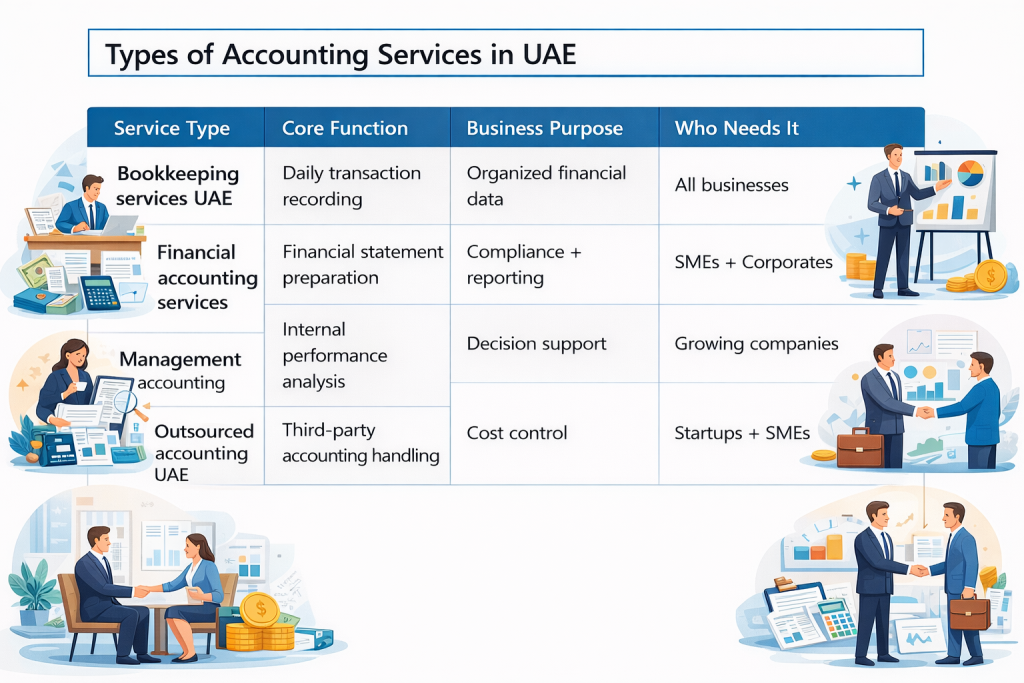
| Service Type | Core Function | Business Purpose | Who Needs It |
| Bookkeeping services UAE | Daily transaction recording | Organized financial data | All businesses |
| Financial accounting services | Financial statement preparation | Compliance + reporting | SMEs + Corporates |
| Management accounting | Internal performance analysis | Decision support | Growing companies |
| Outsourced accounting UAE | Third-party accounting handling | Cost control | Startups + SMEs |
Bookkeeping Services
Bookkeeping services in the UAE handle daily financial entries, including invoices, expenses, receipts, payroll, and bank transactions. Accurate bookkeeping keeps records structured and audit-ready. Authorities like the Federal Tax Authority require companies to maintain proper documentation for tax verification and compliance reviews. Missing entries or unsupported transactions can lead to penalties or reassessments.
Reconciliation forms a key bookkeeping task. Bank balances must match accounting records. Differences signal errors, duplicate entries, or unrecorded payments. Correcting discrepancies early prevents reporting issues later.
Financial Accounting Services
Financial accounting services focus on preparing official financial statements used for regulators, lenders, and investors. Reports must follow standards issued by the IFRS Foundation. These standards define revenue recognition, expense classification, asset valuation, and disclosure rules.
Companies operating in the UAE must present accurate financial statements for tax filings, audits, and regulatory submissions. Professional accountants review data, adjust entries, and verify accuracy before finalizing reports. This process ensures statements reflect a true financial position.
Management Accounting
Management accounting produces internal reports that support business decisions. These reports analyze production costs, departmental spending, profit margins, and operational efficiency. Leadership teams rely on such data before approving investments or expansion.
Cost analysis stands as a major component. Accountants calculate cost per unit, break-even points, and margin percentages. These metrics help companies control spending and maintain profitability.
Outsourced Accounting Services
Outsourced accounting UAE involves hiring external accounting firms in the UAE instead of maintaining an in-house finance department. Service providers manage bookkeeping, reporting, compliance filings, and tax calculations. This model reduces staffing costs and gives access to experienced professionals.
Outsourcing also improves compliance reliability. Professional firms stay updated on regulatory changes, filing deadlines, and reporting standards. Businesses therefore avoid late submissions and incorrect filings.
Legal and Regulatory Framework for Accounting in UAE
1. Accounting Standards Followed in UAE
- IFRS adoption is mandatory for most UAE companies; financial statements must comply with IFRS.
- Financial reporting UAE requires consistency, accuracy, and disclosure of all assets, liabilities, income, and expenses.
- Professional accountants apply financial accounting services to ensure statements are compliant and accepted by regulators.
- IFRS standards guide revenue recognition, expense classification, and asset valuation to prevent errors or penalties.
2. UAE Tax Environment and Accounting
- VAT accounting UAE requires recording all taxable transactions, input tax, and output tax for reporting to the Federal Tax Authority.
- Corporate tax accounting in the UAE involves preparing accurate taxable income calculations in accordance with the Corporate Tax Law.
- Accountants ensure timely submission of regulatory reports and tax returns to avoid fines.
- Accurate accounting allows businesses to claim legitimate deductions and avoid audits.
3. Record Keeping Requirements
- Companies must maintain mandatory documentation for all transactions, including invoices, receipts, bank statements, and contracts.
- Retention periods are generally 5 years for financial and tax records; some authorities may require longer for audits.
- Proper record maintenance ensures smooth audit processes and regulatory inspections.
Bookkeeping services UAE support compliance by keeping records organized and ready for review.
Accounting Services for Different Business Types

1. Mainland Companies
- Compliance needs: Must follow UAE Commercial Companies Law and maintain financial accounting services in line with IFRS.
- Reporting expectations: Annual financial statements, VAT returns, corporate tax filings, and internal audit support.
- Professional support: Accounting firms in UAE help with statutory reporting, reconciliations, and regulator submissions.
- Regulatory bodies: Reports are submitted to the Ministry of Economy and Federal Tax Authority.
2. Free Zone Companies
- Authority requirements: Each free zone (DMCC, JAFZA, DIFC, RAKEZ) defines audit and accounting obligations.
- Reporting obligations: Annual audited accounts, VAT compliance, license renewal submissions.
- Accounting support: Outsourced accounting UAE providers prepare compliant financial statements and handle submissions.
3. Startups and SMEs
- Basic accounting structure: Daily bookkeeping, ledger maintenance, and cash flow tracking.
- Growth-stage needs include VAT registration, corporate tax planning, budgeting, and management reporting.
- Benefits of accounting services: Maintain compliance while keeping costs low, access funding, and track financial performance.
4. Large Corporations
- Complex reporting: Multiple entities, cross-border transactions, consolidated financial statements.
- Internal controls: Cost management, risk assessment, internal audit coordination.
- Advanced services: Forecasting, financial analysis, performance tracking, and strategic planning support.
- Accounting firms in Dubai: Provide expertise in compliance, reporting, and advisory to ensure accuracy and credibility.
Role of Accounting Firms in UAE Businesses
Accounting firms play a central role in maintaining financial accuracy, ensuring compliance, and supporting business decisions in Dubai and across the UAE.
1. Supporting Financial Accuracy
- Accounting services in UAE validate transactions, reconcile accounts, and ensure correct reporting of assets, liabilities, and revenue.
- Reduces errors, omissions, and misstatements in financial statements.
- Enhances credibility with banks, investors, and regulators.
2. Assisting During Audits
- Accounting firms prepare records for internal and external audits, ensuring all ledgers, invoices, and reconciliations are accurate.
- Professional auditors review statements efficiently, minimizing audit delays or regulatory penalties.
3. Preparing for Investors or Funding
- Accurate financial statements support due diligence processes during funding rounds or bank credit approvals.
- Accounting consultants UAE provide insights into profitability, cash flow, and debt ratios.
- Transparent records build investor confidence and simplify negotiations.
4. Helping Management Decisions
- Internal reports, cost analysis, and performance tracking help management make strategic decisions.
- Forecasting and budgeting allow better cash flow management, pricing strategy, and cost optimization.
- Accounting services offer actionable insights beyond statutory reporting.
How to Choose the Best Accounting Firms in Dubai
Key Selection Criteria
- Check if the firm has licensed and approved accountants in Dubai recognized by the Ministry of Economy.
- Verify experience in your industry and business size.
- Ensure the firm understands UAE accounting regulations, VAT accounting UAE, and corporate tax accounting UAE.
- Review the quality and clarity of financial statements and management reports.
- Assess ability to meet compliance deadlines and regulatory submissions.
Benefits of Hiring Professional Accountants in Dubai
Engaging professional accountants brings measurable advantages for businesses of all sizes operating in the UAE. These benefits extend well beyond basic compliance and significantly improve financial control, reporting reliability, and strategic decision‑making.
1. Compliance Confidence
Professional accountants understand UAE accounting regulations, including VAT accounting UAE, corporate tax requirements, and reporting expectations set by authorities like the Federal Tax Authority and Ministry of Economy. Their expertise helps businesses meet deadlines, avoid penalties, and ensure accurate filings. Partnering with established firms such as Prime Edge Tax Consultant ensures that accounting work aligns with local laws and standards.
2. Time and Cost Efficiency
Outsourced accounting services free up internal time and resources. Instead of hiring a full in‑house team, businesses can rely on experienced accountants in Dubai to handle transaction recording, reconciliations, and reporting. This approach reduces overhead costs and eliminates training and staffing challenges.
3. Reduced Financial Risk
Professional accountants apply systematic checks at every stage of the accounting cycle. They ensure that ledgers are accurate, reconciliations are complete, and reports comply with IFRS standards. This reduces the risk of errors, misstatements, and financial discrepancies that could trigger audits or regulatory scrutiny.
4. Accurate Reporting
Reliable financial statements give a clear view of business performance. Accountants prepare profit and loss reports, balance sheets, and cash flow statements that stakeholders trust, including investors, banks, and regulators. Accurate reporting plays a key role in credit approvals, investment funding, and performance evaluation.
5. Strategic Financial Insights
Professional accounting goes beyond recording numbers. Analysts interpret financial data, highlight trends, and provide insights that help management plan budgets, forecast cash flow, and manage costs. These insights support strategic decisions, including expansion, pricing changes, and resource allocation.
6. Support During Audits
When auditors arrive, well‑prepared accounting records speed up the audit process. Professional accountants ensure all documents are organized and reconciled, reducing the time auditors spend on verification. This minimizes disruptions and potential audit findings.
7. Scalability for Growth
As a business grows, accounting complexity increases. Professional accountants scale services to match needs, such as multi‑entity reporting, consolidated financials, and advanced compliance support, without burdening internal staff.
8. Credibility with Stakeholders
Audited and professionally prepared financial statements enhance credibility. Banks, investors, and partners view these reports as trustworthy, which can improve financing terms, attract investment, and strengthen business relationships.
Common Accounting Mistakes Businesses Make
- Poor Record Maintenance
- Incomplete or disorganised transaction records make audits and tax filings difficult.
- Missing invoices or receipts can trigger penalties during regulatory inspections.
- Incomplete or disorganised transaction records make audits and tax filings difficult.
- Late Reporting
- Delayed preparation of financial statements, VAT returns, or corporate tax submissions can lead to fines and rejected filings.
- Timely reporting ensures compliance with deadlines set by the Federal Tax Authority and the Ministry of Economy.
- Delayed preparation of financial statements, VAT returns, or corporate tax submissions can lead to fines and rejected filings.
- Incorrect Tax Calculations
- Miscalculating VAT or corporate tax leads to reassessments and financial penalties.
- Professional accountants prevent errors by applying correct tax rules and standards.
- Miscalculating VAT or corporate tax leads to reassessments and financial penalties.
- Lack of Documentation
- Failure to maintain supporting documents for transactions compromises audit trails.
- Proper documentation is critical for regulatory compliance, audits, and investor confidence.
- Failure to maintain supporting documents for transactions compromises audit trails.
- Mixing Accounting and Bookkeeping Roles
- Treating bookkeeping alone as sufficient for accounting can result in incomplete analysis, inaccurate statements, and poor decision support.
- Treating bookkeeping alone as sufficient for accounting can result in incomplete analysis, inaccurate statements, and poor decision support.
- Ignoring Regulatory Updates
- Businesses often miss changes in VAT rates, corporate tax, or accounting standards.
- Staying up to date ensures reports comply with UAE accounting regulations and IFRS standards.
- Businesses often miss changes in VAT rates, corporate tax, or accounting standards.
- Overlooking Reconciliation
- Bank and ledger mismatches left unchecked create errors in financial statements.
- Regular reconciliations help identify discrepancies early.
- Bank and ledger mismatches left unchecked create errors in financial statements.
- Not Hiring Professional Support
Using inexperienced staff instead of professional accounting services in UAE can cause mistakes, non-compliance, and unreliable financial reporting.
Technology and the Future of Accounting in UAE (2026 and Beyond)
1. Digital Accounting Systems
- Companies increasingly rely on cloud-based accounting software to record, reconcile, and report financial transactions.
- Systems such as Xero, QuickBooks, and Zoho Books integrate VAT and corporate tax modules to ensure compliance.
- Digital accounting ensures real-time visibility into cash flow, expenses, and revenue trends.
2. Automation in Financial Reporting
- Automation reduces manual errors in ledgers, reconciliations, and financial statements.
- Tools generate automated VAT reports, corporate tax calculations, and IFRS-compliant financial statements.
- Advanced analytics help businesses forecast revenue, track KPIs, and identify cost-saving opportunities.
3. Regulatory Digitalization Trends
- UAE authorities are moving toward digital tax filing, e-invoicing, and real-time compliance reporting.
- Free zones such as DMCC, JAFZA, and DIFC increasingly require electronically submitted, audited accounts for license renewal.
- Companies adopting digital accounting solutions can meet regulatory deadlines efficiently and reduce risk of fines.
4. Enhanced Decision-Making Through Data Analytics
- Digital accounting tools allow management accounting insights, including trend analysis, cost tracking, and performance evaluation.
- Businesses can make informed decisions on expansion, investment, or resource allocation.
5. Scalability for Growing Businesses
- Automated systems allow companies to scale operations without proportional increases in accounting staff.
- Startups and SMEs can manage complex transactions efficiently as they grow, while large corporates can consolidate multi-entity data seamlessly.
Why Businesses Choose Professional Accounting Services in UAE
1. Expertise
- Professional accountants bring technical knowledge of UAE accounting regulations, VAT, corporate tax, and IFRS standards.
- They understand complex financial rules, ensuring reports meet legal and regulatory expectations.
2. Compliance Assurance
- Accounting services in UAE ensure timely submission of VAT returns, corporate tax filings, and statutory reports.
- Companies avoid fines, penalties, and rejected filings by relying on experts who stay up to date on regulatory changes.
3. Reliable Financial Insights
- Accountants analyze financial data to highlight revenue trends, costs, and profitability.
- Businesses receive actionable insights for budgeting, forecasting, and strategic decision-making.
4. Long-Term Business Support
- Professional accounting services provide continuous guidance for audits, investor reporting, and financing.
- Outsourced services or firm partnerships help businesses scale without increasing internal accounting staff.
5. Enhanced Credibility
- Accurate and compliant financial statements strengthen trust with banks, investors, and regulatory authorities.
- Professional accounting services demonstrate financial discipline and governance.
6. Cost and Time Efficiency
- Engaging experts reduces operational burden, allowing management to focus on growth while professionals handle bookkeeping, reporting, and compliance.
Final Thoughts
Professional accounting services in the UAE ensure accurate financial records, compliance with VAT, corporate tax, and IFRS standards, and reliable reporting for regulators, investors, and banks. Structured accounting supports audits, cash flow management, and informed business decisions.
Experienced accountants provide timely statements, cost tracking, and strategic insights, reducing financial risks and operational errors. Digital tools and automation are increasingly shaping reporting and compliance practices.
Businesses that partner with experts, such as Prime Edge Tax Consultant, gain credibility, operational efficiency, and long-term growth support, making accounting a vital tool for sustainable success


