
Documents Required for UAE Corporate Tax Registration: Complete 2026 Checklist
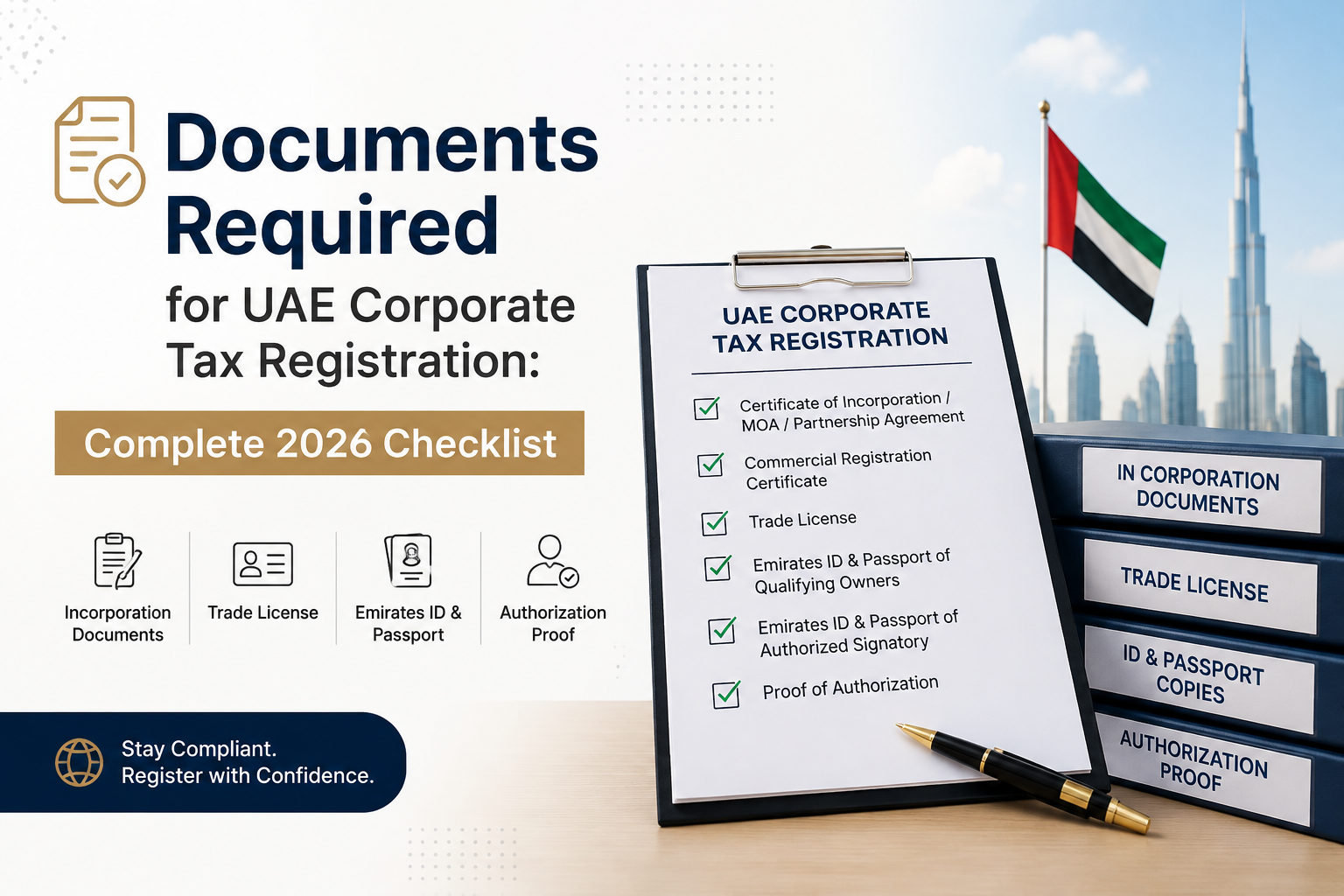
One missing document can push your registration back by weeks, and the delay costs more than time. Late registration triggers a flat AED 10,000 administrative penalty under Cabinet Decision No. 75 of 2023, and that fine applies whether you owe any tax or not. The Federal Tax Authority rejects applications regularly over mismatched names, expired trade licenses, and missing paperwork, and every rejection sends you back to the queue. This guide lists the corporate tax documents required for your application, organized by business type so you’re not sifting through requirements that don’t apply to you. You’ll get the full Corporate Tax Registration Document Checklist UAE for mainland companies, free zone entities, and individual freelancers, along with the exact steps the FTA expects on EmaraTax. Prepare your paperwork correctly the first time, and your Corporate Tax Registration Number arrives without a single back-and-forth email.
Who Needs to Register for Corporate Tax in the UAE?
Mainland companies:
Every mainland business must register, regardless of size or profit level. This covers LLCs, sole establishments, and branches of foreign companies operating under a mainland trade license. There’s no revenue threshold that exempts you.
Free zone companies:
Free zone status doesn’t mean you skip registration. Free zone entities are not exempt from the law itself; their 0% rate on qualifying income is a preferential rate, not an exemption. You still register, and if you want that 0% rate, you’ll need to prove Qualifying Free Zone Person (QFZP) status with the right supporting documents.
Individuals and freelancers:
You need to register if you’re a natural person conducting business in the UAE and your annual turnover crosses AED 1 million. This applies to freelancers, sole proprietors, and anyone running a business activity under a permit rather than a full trade license.
Exempt entities that still must register
This is the part people miss most often. Being exempt from paying corporate tax doesn’t mean you’re exempt from registering for it. Government entities, public benefit organizations, and certain free zone businesses can qualify for exemptions, but they still need to register with the FTA to confirm their status.
Core Corporate Tax Documents Required for UAE Registration
Valid Trade License
- Proves your business is legally registered and operating in the UAE
- Must be issued by the relevant UAE authority and must not be expired
- Business name, license number, and issue date must match exactly across all other documents
- Expired licenses are a top reason for rejection
Memorandum of Association (MOA) or Articles of Association (AOA)
- Sets out your company’s objectives, legal structure, and internal rules for the FTA
- Confirms ownership split and business purpose
- Some license types don’t require an MOA; a Power of Attorney may substitute
- Confirm with your registering authority if unsure which applies
Passport Copies of Owners, Partners & Shareholders
- Required for every owner, partner, or shareholder named on the license and must not be expired
- If a shareholder is a corporate entity, submit its trade license and registration documents too
- Copies must be clear and fully legible
Emirates ID of Owners/Partners
- Required for the owner or partners who own the licence and must not be expired
- Non-resident partners without an Emirates ID can typically submit passport and visa copies instead
- Confirm requirements with your registering authority for mixed ownership structures
Power of Attorney (POA), if applicable
- Only needed when someone other than the owner handles registration (manager, local service agent, or tax consultant)
- Must explicitly name the authorized signatory
- Must state the signatory is permitted to act on tax matters
- Without it, the FTA won’t accept an application from anyone but the registered owner
Contact Details (Company & Authorized Signatory)
- Company’s complete address and P.O. Box
- Mobile number and email for the authorized signatory
- A direct contact the FTA can reach for clarification
- Should match contact details already on file from any prior VAT or Excise Tax registration
Additional Documents for Mainland Companies
- Certificate of Incorporation (for LLCs and other registered legal entities)
- Ownership and shareholder structure chart, if your company has more than one layer of ownership
- Registered office lease agreement or Ejari certificate, confirming a physical UAE address
- Details of branches, if the license covers more than one location, since each branch typically falls under the same TRN as the parent
- Board resolution or shareholder resolution authorizing the registration and naming the authorized signatory, where the license structure requires one
Additional Documents for Free Zone Companies
Standard free zone registration documents
- Free Zone trade license and Free Zone Establishment Certificate
- MOA or AOA showing free zone incorporation
- Lease agreement or flexi-desk certificate from the free zone authority, proving physical presence
Documents Required for Individuals & Freelancers
The turnover threshold
- You become a taxable person once your total UAE business turnover exceeds AED 1 million in a calendar year
- Employment income, personal dividends, savings, and most passive investments don’t count toward that figure
- Registration is due by 31 March of the year following the year your revenue crossed AED 1 million
- Cross the threshold and skip registration, and the FTA can impose penalties ranging from AED 10,000 to AED 20,000
Documents you’ll need
- A valid trade license or freelance permit, including any branch license
- Emirates ID and passport for any owner holding more than 25% ownership, and for authorized signatories
- Certificate of incorporation, MOA, or partnership agreement, where relevant (civil companies and multi-partner setups)
- Proof of business income showing turnover for the relevant calendar year (bank statements, invoices, or a revenue summary)
- Contact details and mobile number for the FTA correspondence
Step-by-Step: How to Submit Documents via EmaraTax
Follow these steps to complete your UAE Corporate Tax Application Requirements and submit the required documents through EmaraTax.
- Gather your documents first. Scan your trade license, MOA/AOA, passport and Emirates ID copies, POA (if applicable), and contact details as PDFs before you start.
- Create your EmaraTax account. Register with your email and phone number, or log in with your existing UAE Pass credentials.
- Add your business as a Taxable Person. Click “Create” on your dashboard if your business isn’t already listed.
- Link your trade license. Connect it to your EmaraTax profile so the system can validate it against the licensing authority’s records.
- Start Corporate Tax registration. Click “Register” under the Corporate Tax tile, read the guidelines, and confirm the checkbox.
- Select your entity type. Choose the option that matches your business, such as a private company, free zone entity, or natural person.
- Enter business and financial year details. Fill in your legal entity type, business activities, and financial year start date.
- Add shareholder and contact information. Enter passport and Emirates ID details for owners and authorized signatories, plus company and signatory contact details.
- Upload your supporting documents. Attach each file in the required format, keep them clearly labeled, and compress anything over the size limit.
- Review your application summary. Check every entry and document one last time before you submit, since this is your final chance to fix an error.
- Submit the application. Send it for FTA review once everything looks correct.
- Track your Tax Registration Number. Approval typically takes 5 to 20 business days. Check your email and EmaraTax inbox in case the FTA requests clarification.
Common Mistakes That Get Corporate Tax Registration Rejected
Mismatched Details Across Documents
The FTA portal cross-checks your information against your trade license. A mismatched legal name, license number, or business activity leads to rejection. Confirm these details read identically across every document before you submit them.
Expired or Outdated Documents
Uploading outdated or unclear documents, such as expired trade licenses or illegible scans, delays approval. Check the expiry date on every ID and license first.
Incomplete Application Forms
Many registration delays occur because businesses do not complete their Corporate Tax Compliance Documents Checklist before submitting the application.
Assuming Exemption Means No Registration Required
Exemption doesn’t happen automatically. You have to submit an application to the FTA and get it approved. Register on time regardless, and apply for exemption separately.
Missing the Registration Deadline
The FTA has issued tiered deadlines based on the month a company’s trade license was originally issued. Many businesses assume there’s one universal deadline and miss theirs entirely. Check your specific deadline on the FTA portal.
Wrong File Format or Oversized Uploads
Technical issues such as unsupported file types, failed uploads, or exceeding EmaraTax’s file size limits stall otherwise complete applications. Stick to PDF format and compress large files.
Not Responding to FTA Follow-Up Requests
Applicants should regularly monitor their EmaraTax account and registered email for notifications or requests from the FTA. An unanswered request stalls your application indefinitely.
Corporate Tax Registration Document Checklist UAE
| Category | Deadline / Threshold | Penalty for Missing It |
| Existing juridical persons (incorporated before 1 March 2024) | Based on trade license issuance month, per FTA Decision No. 3 of 2024, Article 3 | AED 10,000 flat fine |
| Multiple licenses held | Earliest issuance month sets the deadline | AED 10,000 flat fine |
| New companies (mainland or free zone) | Within 3 months of incorporation, effective 1 March 2024 | AED 10,000 flat fine |
| Individuals & freelancers | 31 March of the year following the year revenue exceeded AED 1 million | AED 10,000 flat fine |
| Late filing (first 12 months) | Return due 9 months after financial year-end | AED 500 per month |
| Late filing (from month 13 onward) | Same deadline, extended delay | AED 1,000 per month |
| Late payment | Same 9-month window as filing | 14% annual interest, applied monthly on the unpaid balance |
| Late deregistration | Within required window after ceasing business | AED 1,000 per month, capped at AED 10,000 |
Why You Should Hire a Corporate Tax Consultant for Registration
They Catch Errors That Trigger Rejection
A tax consultant ensures your business registers on time, your taxable income is calculated correctly, and your return is filed accurately. That’s the difference between one-shot approval and weeks of back-and-forth over a mismatched detail.
They Know Which Category You Fall Into
A qualified corporate tax consultant ensures full compliance and minimizes risk exposure. This matters most for free zone businesses proving Qualifying Free Zone Person status, since incorrect documentation means losing the 0% rate without realizing it.
They Track Deadlines You Might Miss
Registration deadlines vary by license issuance month. Professional consultants help businesses build structured compliance systems that reduce risk and improve accuracy across every filing, including tracking your specific deadline before it passes.
They Save You From the Real Cost of Non-Compliance
- AED 10,000 for late registration
- AED 500 per month for late filing in the first 12 months, rising to AED 1,000 per month after that
- 14% annual interest on late payments, applied monthly on the unpaid balance
They Free Up Your Time
A professional consultant can also assist with UAE Corporate Tax File Preparation, including reviewing identification documents, licenses, ownership information, and supporting paperwork before submission.
Hire one if:
- Your business has multiple owners or a layered ownership structure
- You’re a free zone entity pursuing the 0% QFZP rate
- You operate under multiple trade licenses or branches
- You’ve already missed a deadline and need a penalty waiver application
- You don’t have time to manage the process yourself
FAQs
What documents do I need for corporate tax registration in UAE?
You generally need a valid trade license, company identification details, Emirates ID and passport copies of the authorized signatory, and supporting ownership or authorization documents, where applicable.
Do I need a trade license for UAE corporate tax registration?
Yes. Businesses generally need to provide their valid trade license or other relevant business registration document during Corporate Tax registration.
Are financial documents required for corporate tax registration?
Financial statements are generally not required to complete the initial Corporate Tax registration. However, businesses must maintain proper accounting records and financial documents to meet ongoing Corporate Tax compliance requirements.
What documents does FTA require for a corporate tax application?
The FTA may require the company’s trade license, identification documents of the authorized signatory, proof of authorization, ownership details, and other business information depending on the entity and application.
Do free zone companies need different tax registration documents?
Free Zone companies generally provide the same core registration documents, such as their trade license and authorized signatory details. Additional documents may be requested depending on the company’s structure and tax status.
Can I register for corporate tax without company documents in UAE?
No. Businesses need to provide the required identification and business information to complete Corporate Tax registration. A valid business registration document, such as a trade license, is generally required for companies.
What documents are required for LLC corporate tax registration?
An LLC generally needs its trade license, Emirates ID and passport of the authorized signatory, company details, ownership information, and authorization documents where applicable.
What information is needed for EmaraTax registration?
EmaraTax registration requires basic business information, including the legal entity’s name, trade license details, business activities, contact information, ownership details, and authorized signatory information. Supporting documents may also be required based on the entity’s circumstances.
