Understanding UAE Corporate Tax Exemptions: Who Qualifies in 2026?
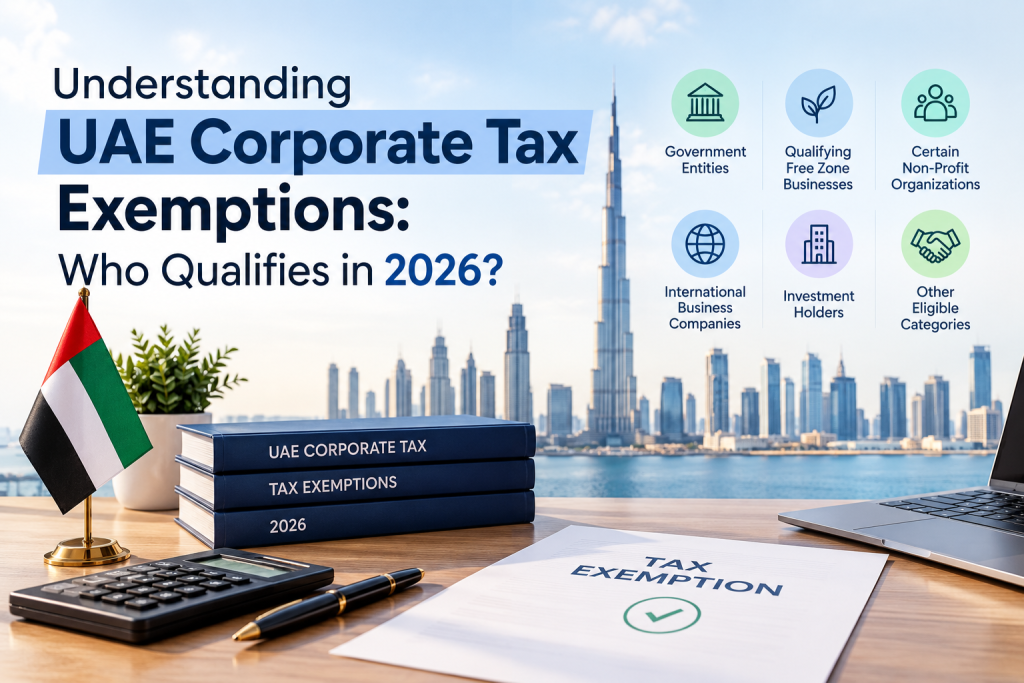
Table of Contents
UAE Corporate Tax applies to many companies and other persons carrying on business in the country, but the Corporate Tax Law provides specific exemptions for certain entities and activities.
A tax exemption should not, however, be confused with paying Corporate Tax at a 0% rate.
For example, a normal UAE business with Taxable Income of up to AED 375,000 is generally subject to Corporate Tax at 0% on that amount, but that does not make the company an Exempt Person under the Corporate Tax Law. Similarly, an eligible small business claiming Small Business Relief is using a tax relief rather than becoming permanently exempt from Corporate Tax.
Understanding these differences is important when assessing UAE corporate tax eligibility exemptions, registration obligations and filing requirements.
Businesses that are uncertain about their Corporate Tax status can speak with a tax consultant Dubai before treating themselves as exempt or applying a 0% rate.
Quick Answer: Who Is Exempt From UAE Corporate Tax?
The Federal Tax Authority identifies the following main categories of Exempt Persons:
| Category | How exemption generally applies |
| UAE Government Entities | Automatically exempt, subject to the law |
| Government-Controlled Entities | Exempt for Mandated Activities where the relevant conditions and listing requirements are met |
| Extractive Businesses | Exempt where the statutory conditions are met |
| Non-Extractive Natural Resource Businesses | Exempt where the statutory conditions are met |
| Qualifying Public Benefit Entities | Must meet conditions and be listed in the relevant Cabinet Decision |
| Qualifying Investment Funds | Exemption generally requires application to and approval by the FTA |
| Certain public/private pension or social security funds | Exemption generally requires applicable conditions and FTA approval |
| Certain wholly owned and controlled entities of Exempt Persons | May qualify where statutory conditions and activities are satisfied |
| Certain additional persons specified by Cabinet Decision | Subject to the applicable decision and conditions |
The FTA specifically distinguishes between entities that are automatically exempt, entities exempt following notification or inclusion in a Cabinet Decision, and entities that must apply to the FTA and obtain approval.
What Is Corporate Tax in the UAE?
UAE Corporate Tax is a federal direct tax imposed on the Taxable Income of businesses and other Taxable Persons within the scope of the Corporate Tax Law.
For a standard taxable business, the general rates are:
| Taxable Income | Corporate Tax rate |
| Up to AED 375,000 | 0% |
| Above AED 375,000 | 9% on the amount exceeding AED 375,000 |
For example, if a company has Taxable Income of AED 1 million, the first AED 375,000 is generally taxed at 0%, while AED 625,000 is taxed at 9%, resulting in Corporate Tax of AED 56,250 before considering applicable tax credits or other adjustments.
Is AED 375,000 the Corporate Tax Exemption Limit?
No.
This is one of the most important points for businesses searching for a corporate tax exemption limit.
AED 375,000 is generally the threshold separating the 0% and 9% Corporate Tax rates for standard Taxable Income. It is not a general exemption from the Corporate Tax Law.
For example:
A company with Taxable Income of AED 300,000 may have no Corporate Tax payable because that income falls within the 0% band.
But the company can still be a Taxable Person, which means registration, return filing and record-keeping requirements may still apply.
That is different from a Government Entity or approved Qualifying Investment Fund that is treated as an Exempt Person.
0% Rate vs Corporate Tax Exemption
| 0% Corporate Tax rate | Corporate Tax exemption |
| Person can still be a Taxable Person | Person qualifies as an Exempt Person |
| Corporate Tax registration may still be required | Registration depends on the exempt category |
| Tax return obligations can still apply | Some Exempt Persons have different compliance requirements |
| AED 375,000 threshold can apply to standard Taxable Income | Based on specific statutory exemption categories |
| Does not itself make a business exempt | Exemption arises under Corporate Tax Law requirements |
This distinction should appear near the top of your article because many competing pages blur the two concepts.
UAE Government Entities
UAE Federal Government and Emirate Government entities, including their departments, agencies, authorities and other qualifying public institutions, can be exempt from Corporate Tax.
The FTA classifies Government Entities as automatically exempt, although taxable business activities outside the relevant exemption can require separate consideration.
This exemption recognises the public-governmental nature of these entities rather than providing a general exemption to companies merely because they work with the Government.
Government-Controlled Entities
A Government-Controlled Entity can qualify for Corporate Tax exemption where it satisfies the relevant requirements and carries out its Mandated Activities.
The important point is that not every activity conducted by a Government-Controlled Entity is automatically exempt.
The FTA’s Corporate Tax guidance explains that where a Government-Controlled Entity carries on a Business or Business Activity that is outside its Mandated Activities, that activity can be subject to Corporate Tax.
Businesses should therefore avoid assuming that government ownership automatically makes every source of income tax exempt.
Businesses Engaged in Natural Resource Extraction
Certain businesses engaged in the extraction of UAE natural resources can be exempt from federal Corporate Tax where the applicable conditions are met.
This is particularly relevant to natural-resource industries already subject to taxation at the Emirate level.
The FTA includes qualifying Extractive Businesses among the persons that may be exempt where the statutory requirements and relevant notification requirements are satisfied.
The exemption is activity- and condition-specific. It should not be interpreted as a general exemption for every company operating in the energy or natural-resource sector.
Non-Extractive Natural Resource Businesses
The Corporate Tax regime also provides an exemption framework for qualifying Non-Extractive Natural Resource Businesses.
These businesses must satisfy the relevant Corporate Tax Law conditions, including requirements connected with their natural-resource activities and Emirate-level taxation.
The FTA places qualifying Extractive and Non-Extractive Natural Resource Businesses in the category of persons that can be exempt after meeting the prescribed requirements and notification process.
Where a company conducts additional activities outside the scope of its qualifying natural-resource operations, those activities need to be assessed separately.
Qualifying Public Benefit Entities
Certain organisations established for public-benefit purposes can qualify for Corporate Tax exemption.
These can include entities established for qualifying:
- Charitable purposes
- Religious purposes
- Cultural purposes
- Educational purposes
- Scientific purposes
- Healthcare purposes
- Environmental purposes
- Other qualifying public-benefit purposes
Being a charity or non-profit organisation does not by itself automatically create the Corporate Tax exemption.
The organisation must meet the requirements of the Corporate Tax Law and be included in the relevant Cabinet Decision. The FTA confirms that charities and other public-benefit organisations are exempt only where the required conditions are satisfied and they are listed accordingly.
Qualifying Investment Funds
A qualifying investment fund can apply for Corporate Tax exemption when it meets the required conditions.
Unlike an automatically exempt Government Entity, an investment fund generally needs to:
- Complete Corporate Tax registration.
- Obtain its Corporate Tax Tax Registration Number.
- Satisfy the Qualifying Investment Fund requirements.
- Apply to the FTA for exemption.
- Receive FTA approval.
The FTA guidance confirms that an investment fund can apply for exemption only after registration and that approved exemption status applies from the Tax Period determined by the Authority.
The rules for investment funds were further updated through Cabinet Decision No. 34 of 2025, which applies to Tax Periods commencing on or after 1 January 2025.
Public and Private Pension or Social Security Funds
Certain public and private pension or social security funds may qualify as Exempt Persons where the prescribed Corporate Tax requirements are satisfied.
These funds sit within the categories for which exemption can require registration and application to the FTA rather than simply assuming exempt status.
The fund should therefore confirm both its eligibility and the applicable registration/application procedure.
Wholly Owned Entities of Certain Exempt Persons
Certain UAE juridical persons that are wholly owned and controlled by qualifying Exempt Persons may also qualify for exemption.
The FTA states that this category can include entities wholly owned and controlled by certain:
- Government Entities
- Government-Controlled Entities
- Qualifying Investment Funds
- Pension or social security funds
The entity must also carry out qualifying activities specified under the Corporate Tax framework.
These activities can include carrying out part or all of the Exempt Person’s activities, holding assets or investing funds for its benefit, or performing activities ancillary to the Exempt Person’s activities where the applicable legislation permits this.
Can Foreign-Owned Entities Qualify for Corporate Tax Exemption?
Foreign ownership does not by itself prevent or create Corporate Tax exemption.
A particularly relevant development is Cabinet Decision No. 55 of 2025, which covers certain entities established under foreign jurisdictions that are wholly owned and controlled by specified Exempt Persons.
Such an entity can qualify where it performs activities such as:
- Undertaking part or all of the Exempt Person’s activity.
- Holding assets or investing funds for the benefit of the Exempt Person.
- Carrying out activities ancillary to those of the Exempt Person.
The Decision applies subject to its conditions and has effect from 1 June 2023.
This is more precise than saying broadly that “foreign companies can receive UAE Corporate Tax exemption.”
UAE Corporate Tax Small Business Exemption: Is There One?
The phrase “UAE corporate tax small business exemption” is commonly searched, but the correct legal concept is Small Business Relief.
Small Business Relief does not turn the business into an Exempt Person.
Instead, an eligible Resident Person that elects for the relief is treated as not having derived any Taxable Income for the relevant Tax Period.
Small Business Relief Threshold in 2026
An eligible Resident Person may elect for Small Business Relief where Revenue does not exceed:
AED 3 million
in the relevant Tax Period and in all relevant previous Tax Periods, subject to the applicable conditions.
Major 2026 Update: Relief Extended to 2029
This is a major gap in many competitor articles.
On 7 August 2026, the Ministry of Finance announced that Small Business Relief had been extended so that the threshold continues to apply to qualifying Tax Periods ending on or before:
31 December 2029.
Older articles may still state that Small Business Relief ends on 31 December 2026. That information is now outdated.
Who Cannot Claim Small Business Relief?
Small Business Relief is not available to:
- A Qualifying Free Zone Person.
- A member of certain multinational groups whose consolidated group revenue exceeds the applicable threshold.
The FTA identifies the multinational-group threshold as more than AED 3.15 billion for this purpose.
Revenue vs Taxable Income
This distinction is critical:
AED 3 million Small Business Relief threshold = Revenue.
AED 375,000 standard 0% Corporate Tax threshold = Taxable Income.
They are not the same calculation.
Is a Free Zone Company Exempt From UAE Corporate Tax?
No. A free-zone company should not automatically be described as Corporate Tax exempt.
Free Zone Persons remain within the UAE Corporate Tax framework and are generally required to register for Corporate Tax.
A Qualifying Free Zone Person (QFZP) can receive:
- 0% Corporate Tax on Qualifying Income, and
- 9% on Taxable Income that is not Qualifying Income.
The FTA specifically confirms that all Free Zone Persons must register for Corporate Tax and that the 0% Free Zone regime is a preferential tax treatment rather than a general Corporate Tax exemption.
This is another important competitor gap because “Free Zone = tax exempt” is both inaccurate and risky YMYL wording.
Exemption vs Small Business Relief vs 0% Tax Rate
This table gives readers the answer quickly:
| Situation | Exempt Person? | Corporate Tax treatment |
| Government Entity meeting relevant rules | Yes | Exempt |
| Approved Qualifying Investment Fund | Yes | Exempt |
| Qualifying Public Benefit Entity | Yes | Exempt |
| Taxable Income up to AED 375,000 | No | Generally 0% rate |
| Eligible Small Business Relief election | No | Treated as having no Taxable Income for that Tax Period |
| Qualifying Free Zone Person | No | 0% on Qualifying Income; 9% on non-Qualifying Taxable Income |
| Ordinary taxable company above AED 375,000 | No | Generally 9% on amount above AED 375,000 |
This section should be high on the page because it directly resolves the user’s likely confusion behind tax exemption, corporate tax exemption limit and small business exemption searches.
Do Exempt Businesses Need to Register for Corporate Tax?
It depends on the type of Exempt Person.
The FTA separates exempt categories by their registration treatment.
For example, Government Entities and qualifying natural-resource businesses generally do not require Corporate Tax registration unless they conduct a taxable business outside the exemption.
Other categories—including certain Qualifying Investment Funds, pension/social security funds and qualifying wholly owned subsidiaries—can be required to register before applying for exemption.
This is why a business should not simply decide that it is exempt and ignore EmaraTax registration requirements.
How to Apply for Corporate Tax Exemption in the UAE in 2026
There is no single exemption application procedure for every category.
This is another weakness in the competitor structure you supplied. A generic “Step 1 to Step 6 exemption application” can mislead Government Entities or entities whose exemption depends on a Cabinet listing.
For persons that are required to apply to the FTA, the process generally involves the following.
Step 1: Confirm the Exempt Person Category
Determine which category under the Corporate Tax Law applies.
For example, a Qualifying Investment Fund should assess investment-fund conditions, while a wholly owned subsidiary must assess ownership, control and permitted activity requirements.
Step 2: Complete Corporate Tax Registration Where Required
FTA Decision No. 15 of 2026 provides that certain categories must submit a Tax Registration application before the Corporate Tax exemption application can be submitted.
Step 3: Meet the Exemption Conditions
The applicant must satisfy the conditions applicable to its particular exemption category.
Merely submitting an exemption application does not create entitlement.
Step 4: Submit the Exemption Application
Where FTA approval is required, the application is submitted after the relevant conditions are satisfied.
Step 5: Meet the New 2026 Exemption Application Deadline
This is particularly important for current content.
FTA Decision No. 15 of 2026, effective 15 September 2026, provides that relevant persons generally apply for exemption after the end of the Tax Period in which the exemption conditions were met, and no later than 90 Business Days from the end of that Tax Period, subject to specified exceptions and transitional rules.
Step 6: Wait for FTA Approval
Where approval is required, the entity should not assume that submitting the application alone guarantees exempt status.
The FTA determines the effective date of an approved exemption under the relevant provisions.
Step 7: Maintain Ongoing Compliance
Exempt status is not necessarily permanent regardless of future activity.
Entities must continue satisfying the conditions associated with the exemption and maintain appropriate documentation and records.
What Documents May Be Required for Corporate Tax Exemption?
The required documentation depends heavily on the exemption category.
Documents can include:
- Corporate Tax registration information
- Certificate of incorporation
- Memorandum or constitutional documents
- Trade or commercial registration
- Evidence of ownership and control
- Government decree or establishing legislation
- Relevant Cabinet Decision
- Regulatory approvals
- Evidence supporting investment-fund status
- Pension or social-security fund documentation
- Financial statements
- Records proving that qualifying activities and conditions are satisfied
For normal Corporate Tax registration, the FTA lists documents such as incorporation documents, commercial registration, a valid trade licence, ownership identification and authorised-signatory documentation. Additional documents may be required for Government Entities and Qualifying Public Benefit Entities.
The exact checklist should therefore be determined by the Exempt Person category rather than using the same documents for every applicant.
What Happens If a Business Incorrectly Claims Corporate Tax Exemption?
A business should not treat itself as exempt simply because it expects to pay no tax.
For example:
- AED 300,000 of Taxable Income does not automatically make a company an Exempt Person.
- Revenue below AED 3 million does not automatically grant Small Business Relief unless the requirements are met and the appropriate election is made.
- Free Zone incorporation does not automatically create Corporate Tax exemption.
- An investment fund does not automatically become exempt merely because it describes itself as an investment fund.
Incorrect treatment can affect Corporate Tax registration, returns, tax payable and potentially administrative penalties.
How to Check Whether Your Business Qualifies for a UAE Corporate Tax Exemption
Start by answering four questions:
- Are you actually within an Exempt Person category under the Corporate Tax Law?
- Is your treatment instead a 0% tax rate or Small Business Relief?
- Does your category require Corporate Tax registration?
- Does it require an application, Cabinet listing, notification or FTA approval?
That short assessment prevents the most common mistake: assuming that “no Corporate Tax payable” automatically means “Corporate Tax exempt.”
Businesses requiring a review of their status can use Prime Edge’s tax consultancy in UAE services for Corporate Tax registration and compliance support.
Frequently Asked Questions About UAE Corporate Tax Exemptions
Who is exempt from Corporate Tax in the UAE?
Exempt Persons can include Government Entities, qualifying Government-Controlled Entities, qualifying natural-resource businesses, Qualifying Public Benefit Entities, Qualifying Investment Funds, certain pension and social security funds, and qualifying wholly owned entities of certain Exempt Persons. The exact exemption process differs by category.
What is the Corporate Tax exemption limit in UAE?
There is no general “exemption limit” of AED 375,000. AED 375,000 is generally the threshold up to which standard Taxable Income is subject to a 0% Corporate Tax rate. Income above that amount is generally taxed at 9%.
Are businesses earning less than AED 375,000 exempt from Corporate Tax?
Not necessarily. Where Taxable Income is AED 375,000 or less, the applicable standard Corporate Tax rate may be 0%, but the business can remain a Taxable Person with registration and filing obligations.
What is the UAE Corporate Tax Small Business Relief threshold?
The Revenue threshold is AED 3 million, subject to the statutory conditions. In August 2026, the Ministry of Finance extended the relief to eligible Tax Periods ending on or before 31 December 2029.
Is Small Business Relief the same as Corporate Tax exemption?
No. Small Business Relief allows an eligible Resident Person making the election to be treated as having no Taxable Income for the relevant Tax Period. It does not make the business an Exempt Person under the Corporate Tax Law.
Are free-zone companies exempt from Corporate Tax?
No. Free Zone Persons are within the Corporate Tax regime and must generally register. A Qualifying Free Zone Person may receive a 0% rate on Qualifying Income if the required conditions are satisfied.
Do Exempt Persons need to register for Corporate Tax?
Some do and some do not. The registration obligation depends on the exemption category. Certain categories must register before applying to the FTA for exemption.
How long do I have to apply for a Corporate Tax exemption?
Under FTA Decision No. 15 of 2026, relevant applicants generally have up to 90 Business Days after the end of the Tax Period in which the exemption conditions were met, subject to specific exceptions and transitional provisions. The Decision took effect on 15 September 2026.
Can an investment fund be exempt from UAE Corporate Tax?
Yes, where it meets the Qualifying Investment Fund conditions and its exemption application is approved by the FTA. Registration is required before the fund applies for exemption.
Can a foreign company qualify for a UAE Corporate Tax exemption?
Certain foreign entities wholly owned and controlled by specified Exempt Persons can qualify under Cabinet Decision No. 55 of 2025 where the relevant ownership, control and activity requirements are met. This is a specific exemption and not a general exemption for foreign businesses.